HomeGuidesNFC or Bluetooth: which kind of physical app blocker to buy
NFC or Bluetooth: which kind of physical app blocker to buy
NFC vs Bluetooth app blockers: what each key actually does at the moment you unlock, which phones support which, how each one fails, and how to choose.
9 min readUpdated 18 Sept 2026
On this page
Every physical app blocker works the same way in outline — your apps stay locked until you bring the phone to an object you deliberately left somewhere inconvenient. The difference between products is what the object is and what the phone has to do to recognise it, and that comes down to two radio technologies. This guide is about choosing between them, not about which brand to buy.
At a glance
| NFC key | Bluetooth key | |
|---|---|---|
| The unlock gesture | A tap, over in a second | Hold the phone against the key for about 15 seconds |
| Phones it works with | Only phones with an NFC reader | Any phone the app supports |
| Battery | None at all — the tag is powered by the phone's reader | A cell you replace (a CR2032 in Spark's case) |
| What it costs | Less, because there is no electronics in it | More, because there is |
| How it fails | The phone has no reader, or NFC is switched off | The cells die, and the key stops answering |
| Can it be copied? | Yes — it is a standard tag | Yes — the signal can be recorded and replayed |
What actually happens when you unlock
With NFC there is no power in the key at all. The reader in your phone energises the tag when the two are almost touching — a few centimetres, per Apple's own design guidance — the tag hands over what it stores, and the app checks it. That is why the gesture is a tap and why the object can be as thin as a sticker.
Bluetooth is the opposite arrangement: the key is a small radio with its own power, announcing itself, and the phone listens for it. Because a radio can be heard across a room, a blocker that unlocked on proximity alone would unlock while you sat next to the key with no intention of using it — so a well-designed one asks for a deliberate act instead. Spark's is holding the phone against the key for about fifteen seconds. That is slower than a tap by design; the delay is the part that gives you time to reconsider.
A tap to unlock. Needs a phone with an NFC reader, which some budget Android phones do not have. No battery, and slightly cheaper.
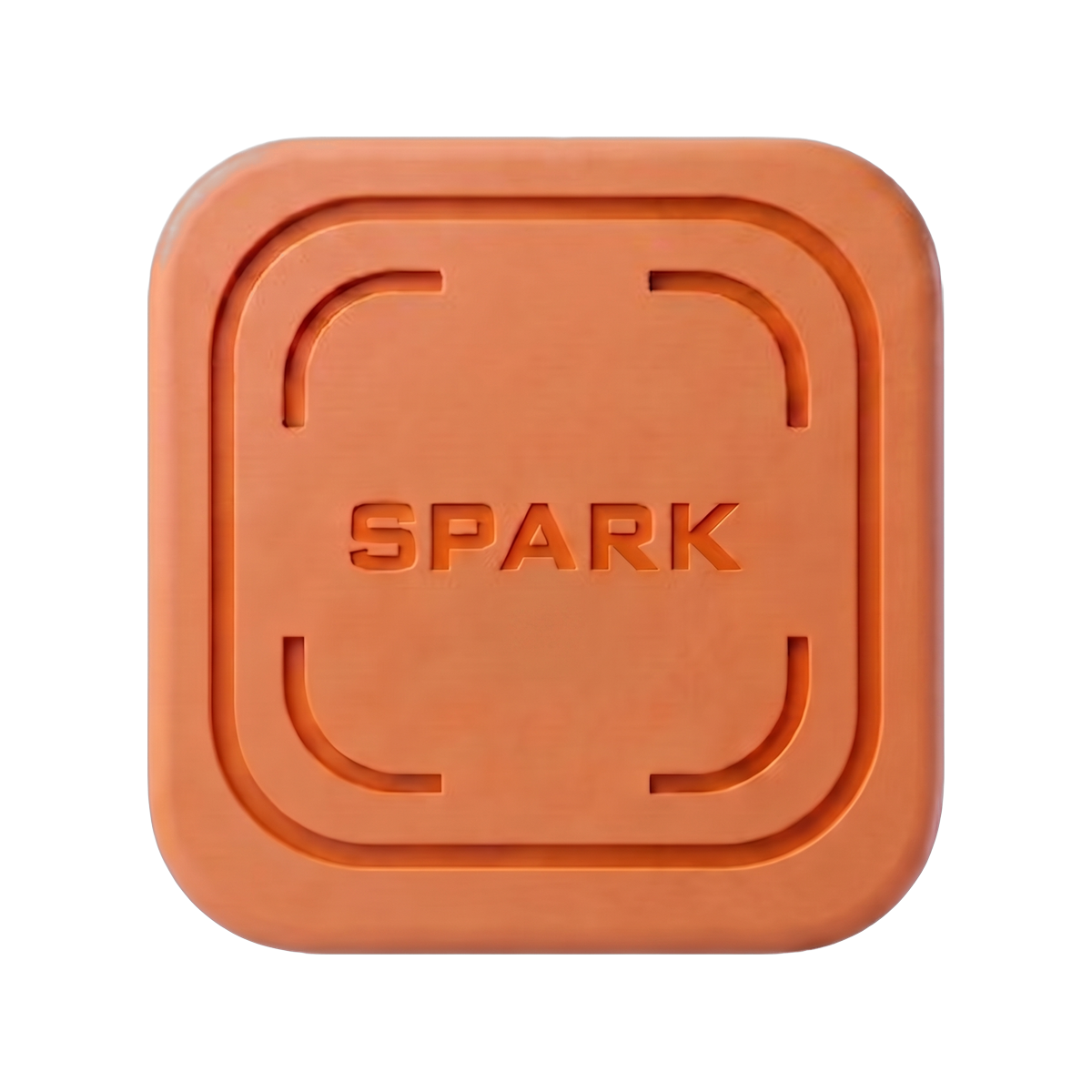 HOLD ABOUT 15 S
Hold the phone against it for about 15 seconds. Works with any phone that runs Spark — iPhone on iOS 17 or later, Android 12 or later. Runs on a CR2032 coin cell.
Device support is the real decider
On Android, an NFC reader is optional. Google's compatibility rules say a phone SHOULD include NFC hardware, which in that document's terms is a recommendation rather than a requirement — so manufacturers decide model by model, and plenty of budget Android phones ship without one. There is no brand-level answer; you check the phone in your hand.
On iPhone the question is simply which iPhone. Apple opened the reader to apps in 2017 with the iPhone 7, and every iPhone that can run iOS 17 is newer than that — Apple's list starts at the iPhone XR and XS. So on any iPhone new enough to run a modern blocker, NFC is there.
This is the one question worth settling before you spend anything, and it takes a minute: search your Android Settings for “NFC”. A setting means a reader; nothing at all almost certainly means none.
How to check whether your phone has NFCThe Settings check on Android and iPhone, what a missing setting means, and a one-tap check that asks the phone's own reader.
Read thisHow each one fails
A key you cannot use is a key that has locked you out of your own phone, so the failure modes matter more than the features. The NFC key has no battery to die, which removes a whole category of problem — but it does nothing if NFC is switched off, and nothing at all on a phone without a reader. If you change phones, you are betting that the next one has one too.
The Bluetooth key's failure is the mirror image: it works with any supported phone, including the next one, and it stops working when the cell runs flat. Spark's takes a CR2032 coin cell and shows its battery level in the app, which turns a sudden failure into a scheduled chore. Whichever you pick, find out before you buy what the escape hatch is — with Spark it is five emergency unlocks, for life, which work with no key and no network, and which Strict mode deliberately switches off.
Neither one is a security device
This is where most marketing in this category quietly overstates things, so plainly: an NFC key is a standard tag and can be copied with a phone. A Bluetooth key that broadcasts a fixed identity — Spark's does — can be recorded and replayed by someone who wants to badly enough. Neither is a cryptographic credential, and a product claiming its key cannot be duplicated is describing something more expensive than any of these.
That sounds damning and mostly is not, because of who the adversary is. You are not defending a bank vault against a stranger; you are making your own idle reach for Instagram cost a walk to another room. Friction that you could defeat with twenty minutes and a second device still works, because at the moment of temptation you will not do that. What it means is that a physical key is the wrong tool if you need to stop somebody else — a child, say — from getting in.
Which products use which
Brick is a purpose-built NFC device: you tap the phone to it to start a session and tap the same device again to end it. Unpluq uses an NFC Tag that only functions while its subscription is live, and offers digital alternatives — shaking the phone for five seconds, for instance — by design. Foqos is iPhone-only and works with commodity NFC tags or printed QR codes, where the QR route has an obvious catch: a code is an image, so it can be photographed and scanned later. Spark sells both kinds of key and lets your phone decide which.
The physical-key products, comparedWhat each product's object actually is, how it gates the unlock, and the honest catch for each — with every vendor fact dated and sourced.
Read this
How to choose, in three questions
- Does your phone have an NFC reader? If not, the decision is made: Bluetooth. If you are not sure, check Settings before you spend anything.
- Is your next phone likely to have one? If you buy budget Android phones, a Bluetooth key survives the switch and an NFC key might not.
- Do you want the unlock to be quick or deliberate? A tap is more convenient. A fifteen-second hold is more annoying, which — for the thing you are buying this for — is a feature, not a fault.
One thing neither kind changes: where the key sits. Both work only when the phone is against them, so both depend entirely on your leaving the key somewhere that costs you a walk. A key in your pocket is a key that unlocks everything the moment you feel like it, in either technology.
Common questions
Is NFC or Bluetooth more secure for an app blocker?
Neither, meaningfully. An NFC tag can be cloned and a fixed Bluetooth identity can be recorded and replayed. Both are friction devices rather than credentials, and the honest way to compare them is by convenience and device support, not by security.
Does a Bluetooth key unlock my phone when I walk past it?
It should not, and Spark's does not. Unlocking takes a deliberate act — holding the phone against the key for about fifteen seconds. A blocker that unlocked on proximity would unlock every time you sat near the key, which defeats the point of leaving it in another room.
What happens to an NFC key if I switch NFC off?
You cannot unlock with it until you switch NFC back on, which takes a moment in Settings or Quick Settings. That is worth knowing before you buy: the key depends on a setting you can change, so it adds friction rather than enforcing anything.
Can I use one key with two phones?
With Spark, no: an account holds one key and one active phone at a time. Check this for any product you are considering, because a household sharing one key is a common plan that most of these products do not support.
Sources
- Android 15 Compatibility Definition, §7.4.4 Near-Field Communications — Phones SHOULD include NFC hardware — a recommendation rather than a requirement, so budget models may omit it.
- Apple: iPhone models compatible with iOS 17 — The list starts at the iPhone XR, XS and XS Max, plus the iPhone SE (2nd generation).
- Apple Developer: Introducing Core NFC (WWDC17) — NFC tag reading opened to apps in iOS 11, on the iPhone 7.
- Apple Human Interface Guidelines: NFC — NFC works between devices within a few centimetres — which is why the gesture is a tap.
- Google Pay Help (India): Get started with NFC — Search Settings for “NFC”; if it is not there, the phone cannot do contactless.
More from the guides
Does my phone have NFC? How to check on Android and iPhone
Does my phone have NFC? How to check in Android Settings or on an iPhone, what a missing NFC setting means, and a one-tap check that asks the phone.
Read the guideFocus in practiceDigital detox devices: what they are, and which one suits you
Lockboxes, dumbphones, timer safes and app keys (Bluetooth or NFC): what each physically prevents, what it costs, and the way each one is defeated.
Read the guideWhy blockers failWhy app blockers stop working after a week
Why do app blockers stop working? Rarely willpower: the off switch sits as close as the on switch. The mechanism, and what actually fixes it.
Read the guideMove the unlock off the phone.
Locking is one tap and never needs the key. Unlocking means getting up and holding your phone against it — a cost your tired self can't pay from the sofa. The app is free; the key is the one-time buy.